
David’s Story: The Family HHT Leaves Behind
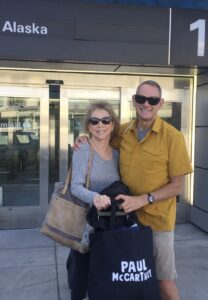
David does not have hereditary hemorrhagic telangiectasia (HHT). But HHT has indelibly shaped his family.
It shaped the life of his father, who lived with chronic nosebleeds but did not fully understand the extent of the disorder. And it shaped the lives of both of David’s sisters, including Carol, whose story we shared earlier this week.
For David, HHT is not theoretical. It is not rare in the way rare diseases can sometimes sound distant or abstract.
It is family history—the inseparable weights of love and worry.
“Visibility is crucial with HHT,” David says. “So little is known about it and the consequences of that can be quite serious.”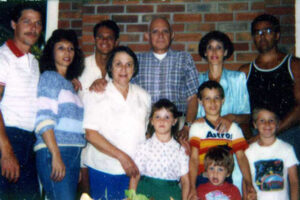
That lack of visibility has been one of the most painful threads running through his family’s experience. His father knew his chronic nosebleeds were related to HHT, but he did not know about AVMs or how dangerous they could be when they affect vital organs. He did not know what research and medicine would later make possible. He died suddenly at 68 from an aneurysm, David believes may have been related to HHT.
Years later, David’s family suffered an even more devastating loss.
His 24-year-old nephew died while awaiting a heart-lung transplant. The family had thought he had asthma. Instead, he had pulmonary hypertension caused by HHT. He was young, talented, funny, and bright—an accomplished musician who had already played Carnegie Hall with the Berkeley Youth Symphony.
“The saddest day of my life was the day my 24-year-old nephew died,” David says.
For a while, David says, the family held together under the strength of his mother, who became the family’s steady center. She did not have HHT, but she became a caretaker in every sense of the word. She was present at home, at medical appointments, and in hospital rooms. She provided practical and emotional support. She worried, but she did not complain. She carried the work of care with humor, resilience, and devotion.
 She was also, David remembers, “a master in getting blood stains out of clothes.”
It is a small detail, but it tells a larger truth. HHT does not only affect the person diagnosed. It changes the household. It changes the rhythm of family life. It changes what support looks like. It asks people to become advocates, drivers, comforters, researchers, emergency contacts, and steady hands when everything feels uncertain.
For David, speaking about HHT means being honest about what the disease has cost his family — and what progress has made possible.
Because his family’s story is not only one of loss.
His surviving sister, Carol, is living proof of what can happen when HHT is recognized, treated, and managed with expert care. After decades of severe anemia, bleeding, transfusions, and medical uncertainty, she is now receiving care through an HHT Center of Excellence. Treatment has dramatically improved her quality of life. She is active, engaged, surrounded by children and grandchildren, and still exploring the world one concert, trip, and family moment at a time.
“The benefits of funding HHT research and education far outweigh the costs,” David says. “My sister is living proof of this.”
That contrast is what makes visibility urgent.
David has seen what happens when HHT is misunderstood, minimized, or missed. He has also seen what happens when the right physician understands the disorder. That is why Visible Together matters to him.
During HHT Awareness Month, David’s story reminds us that HHT is never only one person’s diagnosis. It moves through families. It changes siblings, parents, children, caregivers, and generations still learning what this disease may mean for them.
But it also reminds us that the future can be different.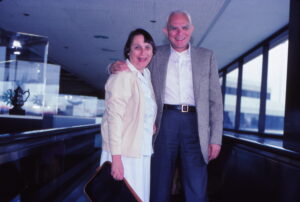
A gift to Cure HHT helps advance the awareness, research, education, advocacy, and expert care that families urgently need. It helps move HHT from invisible to understood.
Make a gift today to Cure HHT’s Visible Together campaign and help bring HHT into the light—for patients, for families, and for those still waiting for answers. Thanks to a generous group of donors, a significant portion of gifts made during HHT Awareness Month will be matched.
Make a gift today and help us make HHT visible.
I am in my late 80s and have always been thwarted in so many things I wanted to do because of nosebleeds. They are terrible for anyone, especially when they occur in public. As a college lecturer I often had to flee my classroom to care for a nosebleed that came out of nowhere. As a musician, I had to perform in fear. All sufferers of HHT are aware, that you cannot live a normal life if you have HHT. But I caught a big break! My daughter, who is a surgeon, insisted that we go see an ENT specialist an hour away. He confirmed that I had very bad telangiectases in both nostrils, but like me, he knew that surgery was not a permanent treatment. In fact, I had already endured three surgeriets throughout my life that benefited me only a few months.
This doctor recommended coconut oil treatment. I was not impressed. But when you’re desperate you’ll ry anything. I was to cover my finger with coconut oil and then gently rub it using only my index finger (carefully, of course) to my nasal lining clear to the back, making sure there is a light amount of oil in the nasal passage, especially toward the back. , but covering the entire nasal passageway. I know this really sounds awful. BUT IT WORKS! I use the oil about three times daily and now I rarely have a bleed. I actually. I have a new lease on life and no longer have the overpowering fear of having an unexpec ted nosebleed. Perhaps this doesn’t work with other types of HHT, but it has given me confidence to do whatever I want without fear. And it’s such a simple treatment!
I believe you! I have tried all kinds of stuff inside my nose to help me breath better and to keep blood from drying out in there.
I will try the coconut oil, it has so many benefits in our body.
Awesome. X ❤️ X
I have HHT. I had an aneurysm and stroke at the age of 8 in 1978. Back then it didn’t have a name, it was just clusters of abnormal blood vessels in the brain. I had to learn to walk and read again at the age of 8. I read from right to left not left to right. It left me with a weak left side. At 34, I was terribly anemic and my Oxygen stats were hovering at 89%. I was sent to a hematologist, then a pulmonologist. I had been trying for months to get a CT, but insurance wouldn’t approve it. I walked into the pulmonologists office and 5 minutes later I was in the hospital on my way to KU med for lung surgery. My nose bleeds at night when I sleep so I just roll over and wait and go back to sleep as I can’t get up. I have had 1 brain surgery, 1 spinal surgery as I had a big one in my spine funneling blood away from my already weak left leg. I’ve had 5 lung surgeries, most can’t be finished as there is only so much dye that can be introduced into your body. I have a small avm in my lungs now that can’t be reached by the normal means so it is being watched. I’ve had about 3 infusions a year for the last 15 years at least. I haven’t ever felt good. I also have a thickened heart which I believe comes partly from the anemia. My hospital bill in 1978 was over $100,000. I usually spend about $26,000 a year between health insurance and my medical bills. This disease is a real bummer.
Hi Lori,
Sorry to read about all your bleeding issues. Have you seen new therapies to HHT patients?
Frank