
Reflections from the Next Generation

There is a particular kind of inheritance within the HHT community — one that passes through DNA and dinner-table stories, through memories of unexplained nosebleeds, iron infusions, and years spent searching for a diagnosis that could name it all. For many families, hereditary hemorrhagic telangiectasia (HHT) was once a shadowy presence, recognized only in hindsight, stitched into generations who carried symptoms without answers.
But could that legacy be shifting?
A new generation is coming of age with a different kind of awareness — earlier, clearer, and supported by a community their parents never had. They are growing up not only with the vocabulary of HHT, but with the conviction that understanding this disease is the first step toward changing its future.
They carry their families’ history, yes — but they also carry a determination that is uniquely their own.
The Weight of What They Inherited
Before we talk about the next generation, we must honor the ones who came before.
For decades, families navigated HHT without the words to describe it. Parents recognized patterns but not diagnoses. Grandparents endured symptoms quietly, believing their struggles were simply “how things are.” Generations carried a condition they didn’t know how to name, let alone challenge.
Their persistence — their advocacy, their insistence that something deeper was happening — built the foundation on which today’s progress stands.
This new generation is not starting from scratch.
They are starting from a legacy carved out by courage.
And with that foundation beneath them, their story begins differently.
A New Awareness, Arriving Sooner
We know the diagnostic odyssey for HHT has always been too long. In fact, it takes nearly five times longer to diagnose HHT than the average rare disease — a journey that can stretch across decades, filled with intense symptoms and contradictory answers.
Cure HHT has been working to change this trajectory through a multi-layered approach: publishing international screening guidelines, certifying institutions as HHT Centers of Excellence, raising public awareness, and educating clinicians with targeted continuing education.
Those initiatives have begun to bear fruit. Early studies show that today’s patients are receiving accurate diagnoses faster than any generation before them.
“I was 13 when I realized my life was going to be different,” said Daniella, 22. “Endless appointments. Taking my health seriously. That was the moment I knew HHT wasn’t going away.”
Another young adult, Morgan, 18, shared, “Knowing earlier changed my experience. It meant I had answers. I knew why I was getting nosebleeds; I learned more specialized ways to treat them, and I learned what to avoid to protect my health.”
Earlier awareness doesn’t erase hardship — but it does shift the terrain. Instead of wandering through uncertainty, young adults are stepping onto a clearer path, lined with resources, community, and a language for what they’ve lived through.
Growing Up in the Age of Possibility
To grow up with HHT today is to live at the intersection of fear and possibility.
These young adults wrestle with questions their parents didn’t know to ask — about screening, genetic testing, pulmonary shunts, iron levels, anesthesia risks — yet they also hold tools their parents never had.
This clarity doesn’t remove the weight HHT carries, but it reframes it. Knowledge becomes a kind of armor. Connection becomes medicine. Community becomes constant.
They are growing up in an era where hope isn’t abstract — it’s measurable, visible in trial announcements, research publications, and medical conferences now filled with providers eager to learn.
This is the age of possibility — and they know it. And in a world where answers no longer feel out of reach, connection has become one of the most powerful tools they have — especially the kind found in unexpected places.
The Digital Village
You’ve heard the saying, “It takes a village.” For those living with underrepresented medical conditions, this phrase takes on a whole new meaning. And unlike the generations before them, Generation Z is not navigating HHT in isolation. Online communities have become the modern village — bringing a lifeline straight to their phone, tablet, or computer screen.
Layla, 17, shared, “Seeing everyone share their stories online — finding others with similar experiences — helped me feel less alone in this battle. It gave me hope that more discoveries and better treatments are coming.”
And for AnnMarie, 26, online connection transformed into activism. She launched a jewelry business and donates part of her sales to Cure HHT. “I wanted patients to know awareness is happening,” she said. “I wanted to create a safe place for others like me.”
In these digital spaces, young people are finding not only solidarity, but courage — a reminder that the burden they carry is shared, understood, and never borne alone.
A Generation That Refuses to Stay Quiet
Where their parents fought for a diagnosis, these young adults are stepping into the next chapter: advocating for equitable, affordable access to care and a future shaped by research, not luck.
“I talk about HHT to everyone,” Daniella said. “If my story helps even one person get answers, it’s worth it.”
Layla learned the stakes early, watching her younger brother suffer up to eight nosebleeds a day while doctors struggled to connect the dots. “I don’t want any more kids to be told they just have to deal with it,” she said.
And for AnnMarie, advocacy is a response to her family’s silence. “I feel responsible for raising awareness,” she said. “I will stand and talk about my experience for those who can’t or won’t.”
If previous generations survived HHT quietly, this one is determined to speak loudly — not out of desperation, but out of hope for what is possible.
Looking Ahead — With Hope That Feels Earned
When asked what these young advocates hope HHT care will look like ten years from now, their responses are bold and deeply hopeful.
“A cure,” Daniella said simply.
Morgan hopes for widespread awareness — among clinicians, schools, and families — so no one waits years for answers.
Layla hopes genetic testing and screening become affordable and routine.
AnnMarie imagines a future where HHT treatment is accessible to all: “We’ve made remarkable progress in the last decade. I truly believe we’ll get to a cure — one everyone can access.”
Their optimism isn’t naïve. It’s grounded in the momentum they see: expanding Centers of Excellence, new clinical trials, stronger guidelines, smarter technology, and a community that is finally being heard.
A Call from the Next Generation — and to the Rest of Us
For every young advocate stepping forward today, there are generations behind them who carried this mission long before it had a name — parents who insisted something wasn’t right, grandparents who endured symptoms in silence, families who fought for care when the world didn’t yet recognize HHT.
Their persistence — and every victory won along the way — created the foundation this generation now stands on.
Now, the next generation is ready to pick up that torch.
They are asking all of us — young and old, newly diagnosed and long familiar — to step into this moment together. To honor the work that brought us here by pushing the future even further.
Because the progress we celebrate today was built by those who came before — and the breakthroughs of tomorrow will be shaped by all of us choosing to keep going, side by side.
Together, we can build the world every generation before us hoped to pass down: A world where HHT is recognized early. Where care is equitable. Where research is fully funded. And where a cure is no longer a distant hope, but available to all.

Valaree Machen
Senior Manager,
Marketing and Communications,
Cure HHT
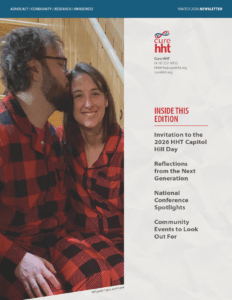 This letter is featured within the 2026 Winter Newsletter, now available digitally. Find important resources, announcements, programs, stories from staff, community updates, and more. Download your copy today.