
New Evidence, Clearer Urgency: What the Latest HHT Study Shows
A major new study published in Blood shares early findings from CHORUS, the first national U.S. registry created to track the real-world impact of HHT. The report includes data from the first 600 participants enrolled across 15 HHT Centers of Excellence and confirms what patients and families have known for years: HHT is not just about nosebleeds. It is a serious, whole-body disease that can lead to major complications when it is missed or diagnosed too late.
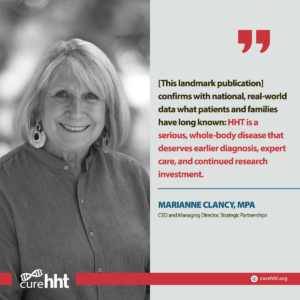
“This publication is a landmark moment for the HHT community,” says Cure HHT Chief Executive Officer Marianne Clancy, MPA. “It confirms with national, real-world data what patients and families have long known: HHT is a serious, whole-body disease that deserves earlier diagnosis, expert care, and continued research investment. We are proud that Cure HHT was able to launch the CHORUS registry, and we are hopeful this publication will help drive better awareness, better care, and better outcomes for families living with HHT.”
This publication matters because it gives the HHT community something powerful: strong national data published in one of the most respected journals in hematology. The findings show that HHT carries a high burden of severe bleeding, iron deficiency and anemia, stroke and blood clots, brain hemorrhage, and heart and lung complications. The study also found that many of these serious outcomes may happen during a long diagnostic gap, since symptoms often begin early but diagnosis is frequently delayed by more than two decades.
Key Takeaways For Patients
This study is a reminder that HHT can affect much more than the nose.
Among the first 600 people in CHORUS:
-
- 95% had recurrent nosebleeds
- 30% had chronic gastrointestinal bleeding
- 68% had iron deficiency and/or anemia
- Many required IV iron or blood transfusions
The study also found that serious complications can happen early. Most participants developed typical HHT symptoms by age 13, but most were not diagnosed until adulthood.
Researchers found:
- Brain AVMs in 15% of screened participants
- Pulmonary AVMs in 47%
- Intracranial hemorrhage in 3%, with most first brain bleeds happening by age 25
The takeaway is simple: early diagnosis matters. Getting diagnosed sooner can help people access screening, expert care, and treatment before preventable complications happen.
Key Takeaways For Healthcare Professionals
This paper offers one of the clearest U.S. pictures to date of the full burden of HHT. The CHORUS data shows high rates of moderate-to-severe bleeding, anemia, AVM-related complications, thrombosis, and neurologic and cardiopulmonary events in a large multicenter patient population.
It also reinforces the need for earlier recognition and proactive screening. Most participants developed symptoms long before diagnosis, and serious events, including intracranial hemorrhage, often occurred before patients were formally identified with HHT. Genetic testing was performed in only 60% of patients in this cohort, highlighting ongoing gaps in diagnosis and management.
For clinicians, these findings support a multidisciplinary model of care, regular monitoring for iron deficiency and anemia, and continued efforts to strengthen screening and long-term management.
A Turning Point For HHT Research
This publication is not the finish line. It is the foundation.
CHORUS provides reliable, real-world data that can help researchers and clinicians better understand how different genetic mutations relate to complications, measure the true burden of AVMs and other manifestations, identify gaps in screening and care, strengthen clinical guidelines, and support the development of better treatments. The registry also provides the kind of evidence policymakers, funders, and industry partners need to understand the true burden of HHT.
That is especially important because there are currently no FDA-approved medications specifically for HHT, even though three-quarters of patients in this study experienced moderate-to-severe bleeding. CHORUS helps create the evidence base needed to advance drug development, regulatory engagement, and sustained federal investment. This is precisely the kind of infrastructure Cure HHT has worked to build: a resource shaped by patients, clinicians, researchers, advocates, and federal partners working together toward earlier diagnosis, better treatments, improved outcomes, and longer, healthier lives for people with HHT. The registry is still growing, and every additional patient strengthens its power to drive progress.
You can access the paper digitally, here.
Read the full press release, here.
This is great news. It’s also a little scary since I didn’t know how common pulmonary AVM’s were. I’m one of the lucky ones, I have had great success with Avastin and a pretty mild case. But I am an exception and I know it. I hope this leads to bigger and better things for the entire HHT Community!