Honoring the People Who Built the HHT Field—and Those Building What Comes Next | Awards
At every scientific conference, there are moments when we look forward: toward the next question, the next clinical trial, the next discovery that could change what it means to live with HHT.
But progress also asks us to look back.
To recognize the people who asked the questions before there were answers. The clinicians who built expertise where little existed. The leaders who connected a scattered community and helped turn HHT into a global field of research. And the young investigators now bringing their own ideas, energy, and ambition to the work ahead.
Last night at the 16th International HHT Scientific Conference, Cure HHT was proud to recognize researchers, clinicians, leaders, and emerging investigators whose contributions tell that story.
And this year, for the first time, we added a new honor.
The Founders Award

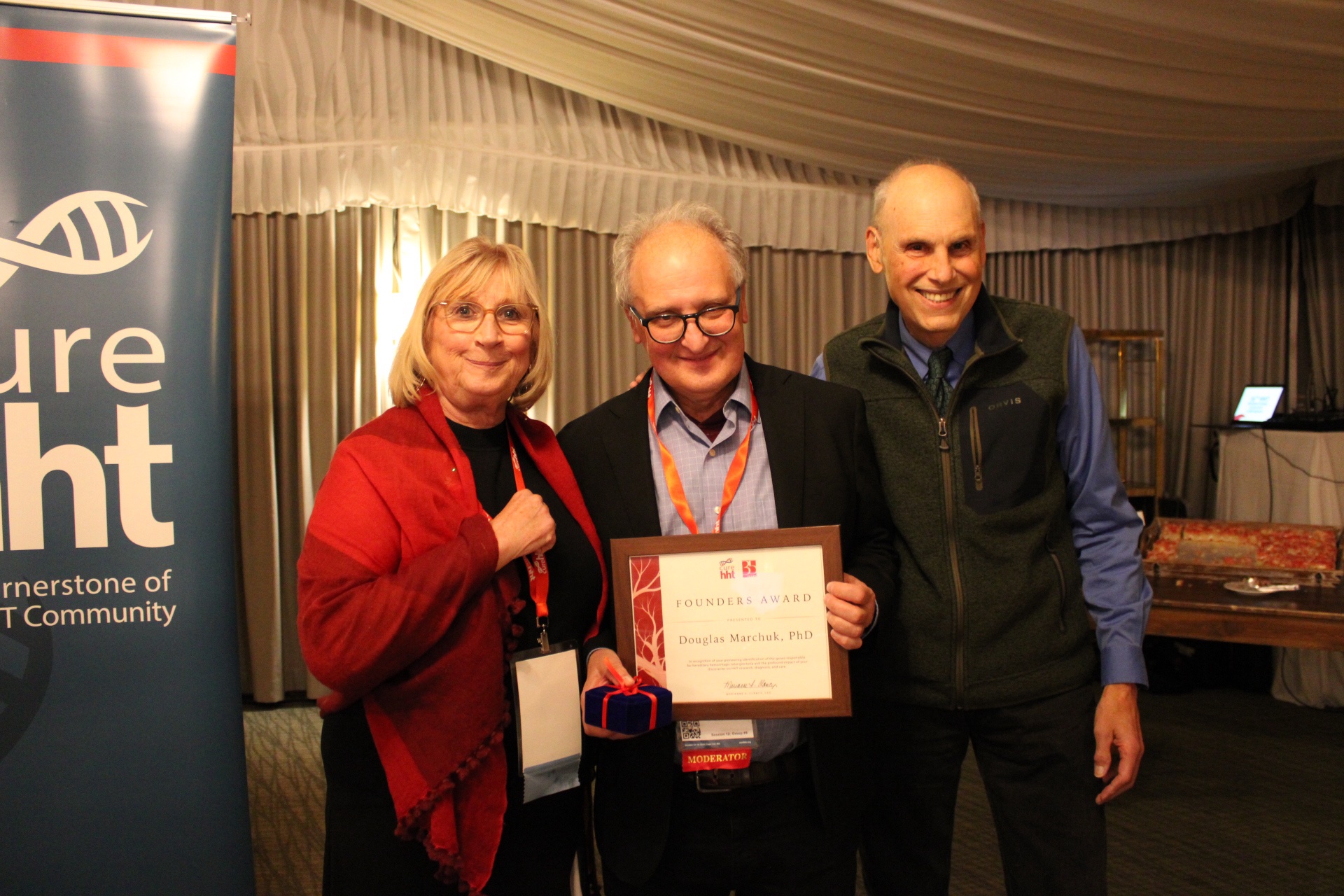
The inaugural Cure HHT Founders Award recognizes individuals whose contributions fundamentally shaped the HHT field and created a foundation upon which today’s progress has been built.
Its first recipient, Douglas Marchuk, PhD, helped change what the world knew about HHT at its most fundamental level.
Dr. Marchuk was recognized for his pioneering identification of the genes responsible for hereditary hemorrhagic telangiectasia—discoveries that profoundly advanced HHT research, diagnosis, and care.
It is difficult to overstate the importance of that work. Understanding the genetic basis of HHT did more than answer a scientific question. It opened new questions. It gave researchers a clearer path into the biology of the disease. It strengthened diagnosis. And decades later, those discoveries continue to inform the work unfolding across laboratories, clinics, and clinical trials around the world.
To help mark that legacy, Dr. Francis Collins, former Director of the National Institutes of Health, joined us by video to present Dr. Marchuk with the inaugural award.
But there was one more Founders Award to present.
And this one had been kept very carefully under wraps.
For 25 years, Marianne S. Clancy, MPA, has helped build the organization and community that surround so much of the progress we see today. As Cure HHT’s first Executive Director and Chief Executive Officer, Marianne helped create the foundation upon which decades of advancement in HHT research, care, advocacy, and community have grown.
So, in a moment that came as a complete surprise to her, Cure HHT Board Treasurer Michael Nolan presented Marianne with the second inaugural Founders Award.
It was recognition not simply of longevity, but of what 25 years of determined leadership can make possible: researchers connected to one another, patients connected to expert care, families given a place to turn, and an entire field pushed forward by the belief that HHT deserved greater attention—and a different future.

Leadership that moves a field forward
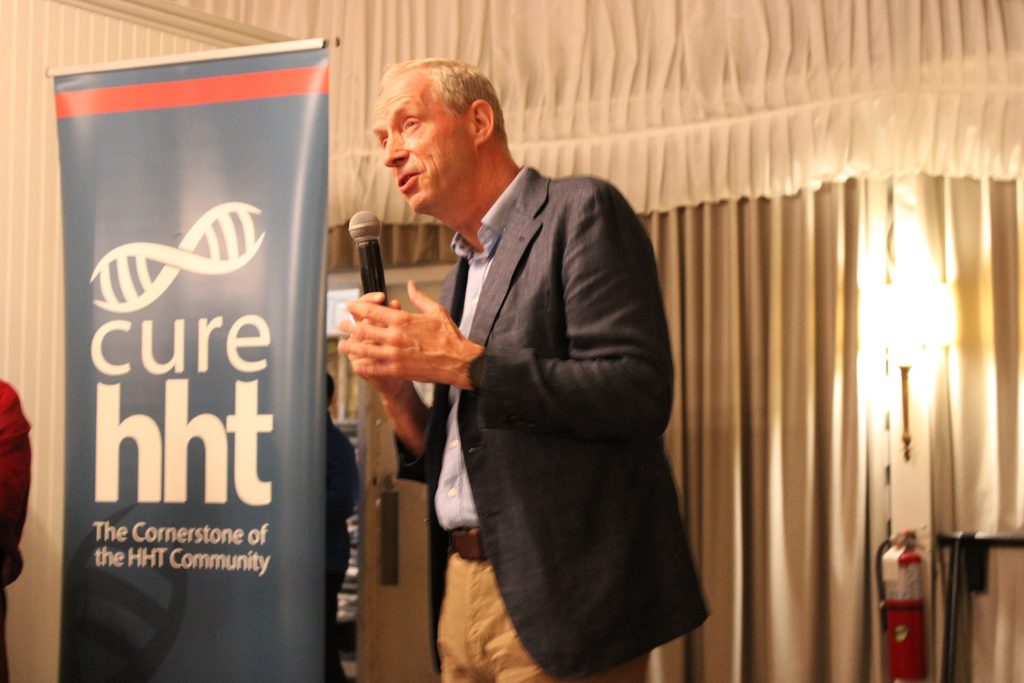
The Robert E. Berkman Leadership Award was presented to Hans-Jurgen Mager, MD, PhD, in recognition of his exceptional leadership and steadfast service to the global HHT community through Cure HHT’s Global Research and Medical Advisory Board.
His work has helped foster collaboration, strengthen clinical excellence, and advance HHT research and care across an increasingly connected international community.
That kind of leadership often happens quietly: convening people, sharing expertise, creating consensus, and making it easier for the next person to move an idea forward. But it is essential to the progress of a rare disease field.
Carrying forward a legacy of compassionate care
This year’s Robert I. White, MD Award was presented to Jenny Zhou, MD, and Kristen Lee, MD. Both were recognized for compassionate care, clinical dedication, and a commitment to advancing the treatment of HHT while carrying forward the spirit of mentorship, discovery, and service exemplified by Dr. Robert I. White Jr.
The award honors a legacy that has always been about more than clinical expertise alone. It recognizes the kind of clinician who pairs knowledge with compassion, improves care for the patient in front of them, and helps build expertise that will reach countless others.
Drs. Zhou and Lee represent exactly that future.
Uplifting and honoring mentorship
The Pay It Forward Award is given to an individual (or in this year’s case, individuals) in recognition of their commitment to investing in the next generation of clinicians through mentorship, generosity, and guidance. This award is given in honor of Scott Olitsky, MD, MBA, and his enduring belief in nurturing young scholars and strengthening the future of HHT care.
This year’s awards were presented to Akash Mathavan, MD and Akshay Mathavan, MD, both of the University of Florida.
A glimpse of what comes next
Perhaps nowhere was the future of HHT more visible than in this year’s Grace Nolan Award and Palmer Family Award recipients.
The Grace Nolan Award supports emerging HHT researchers and honors Grace Nolan’s enduring legacy by investing in the knowledge, collaboration, and discovery that can create a better future for families affected by HHT. This year’s recipients were Ana Braslavsky, MD; Adriana Macko-Walker; Akhil Nagulapalli, MS; Cecilia Alonso Ruiz, MD, PhD; Camila Chiesa, BEng; Isaac Kim, BS; John Fountain, MD; Jonah Keller, BA; Jonathan Le, MD; Karina Al-Dahleh, MSc; Kristina Day, BS; Kimberly Wagas; Matthew Halber, BS; Seoiyoung Ahn, MD, MS; and Tiago Soares, MBBCh, MSc.

The Palmer Family Award recognizes emerging investigators whose work reflects the Palmer Family’s commitment to mentorship, discovery, and the next generation of HHT leaders. This year’s recipients were Andrej Shoykhet; Elaine Kim; Elisavet Koutala, MSc; Eleanor Steiner, BA; Fan Wu, PhD; Joline Michiels, PhD; Jan Pieter van Veen, MD; Ons Mamai; Sartaaj Walia; and Yue Qi, PhD.
Together, these young researchers offer a glimpse of a very bright future for HHT.
They are entering a field that looks profoundly different from the one its earliest pioneers encountered. There are genes to study. International collaborators to learn from. Clinical networks, patient data, biological samples, established expertise, and increasingly, promising therapeutic paths to pursue.
That did not happen by accident. It happened because people built it.
And perhaps that is what this year’s awards made most visible: progress in HHT is generational.
At Cure HHT, we are deeply grateful to every person recognized this year—and to the many researchers, clinicians, families, advocates, and partners whose work surrounds theirs.
Because the future of HHT is being built right now.
And judging by the people carrying it forward, it is in very good hands.